History of the House
Saling Hall is a Grade II* listed country house, situated in the small village of Great Saling, one of a number of small villages distributed in a historical settlement pattern across a western segment of the North Essex countryside.
There has been a house on the site since the 1100s, though the present building was constructed originally mainly in timber-frame in c.1570 by John Maxey. At this time the house would have been on an E-plan form, with west and east wings stretching northwards from the central range and an entrance from the north.
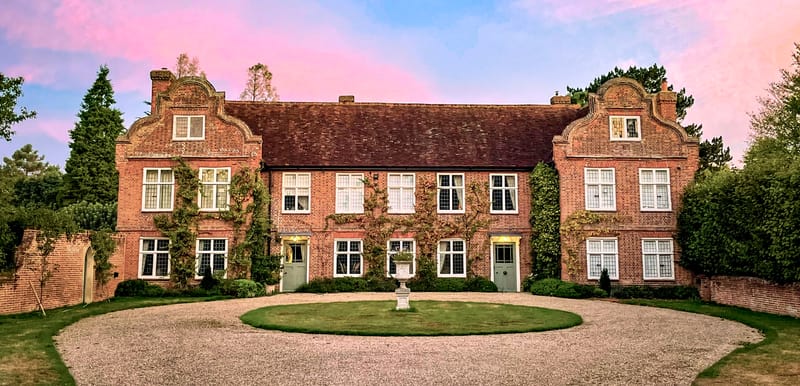
The house was transformed across the 1680–1700 period by Martin Carter, refaced in high quality brickwork on its southern, western and eastern elevations (the western elevation perhaps earlier than the other two) and with — late examples of — ornamental Dutch gables added projecting forwards from the southern elevation.
Internally, a very fine wooden staircase was added in the west wing at this point, alongside many other internal alterations. Much of the house's original timber frame structure was presumably destroyed during this time, with limited timber frame surviving today only in the west wing. The resulting enlarged house would have been on an H-plan form and sat as one of the more substantial houses in North Essex.
The Walled Garden was added to the immediate west of the house in 1698 and remains largely in its original form today. It is listed Grade II in its own right by Historic England.
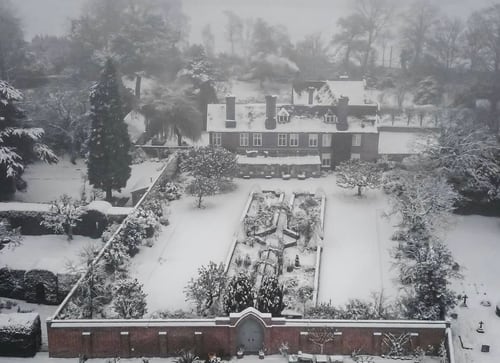
Saling Hall's fortunes waned somewhat in the 1800s as the house became diminished in significance by the construction of Saling Grove at the south of the village, with the owner's daughters living at Saling Hall with their husbands. After about 1830, the house saw a period of multiple occupation by three families, which also created the current arrangement of two main entrance doors on the south elevation.
Around 1860, a significant fire substantially shortened the east wing and some of the northern central portion of the building, the latter then seeing low quality replacement additions to aid basic building circulation.
The house returned to sole occupation during the 1900s, initially tenanted and then for the majority of the century owned first by Lady Isabel Carlyle and then Hugh and Judy Johnson. Additions and changes to the building during that time were piecemeal and largely functional to the north, while a glasshouse-style lean-to conservatory within the walled garden against the west elevation was added in the 1980s.
The House Today
Hugh and Judy Johnson left Saling Hall in 2013, following which the house was empty for five years, with an approved scheme to convert the house to a hotel never executed.
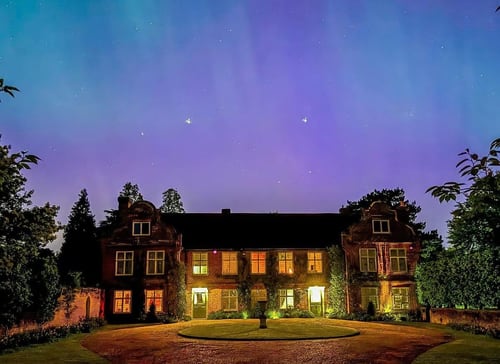
In 2018 Matthew and Jennifer O'Connell acquired Saling Hall and undertook an extensive, sensitive restoration and modernisation of the house. Today it is a busy family home, with three young children and two miniature schnauzers.